 I get several hundred pitches in the course of a typical day. It’s part of the job — startups, PR agencies and big tech companies pitch us on their products, and we decide which ones are the best fit for our readers.
But going through hundreds of pitches every single day is rough. We (journalists) can’t possibly go through every email, so we look for signals that help us sort out the stories we want to follow up on and the stories we need to trash.
One of the signals that can get your email trashed is the use of buzzwords. While not every pitch with a buzzword in the subject is a bad pitch, most of them turn out to be for crappy products that don’t stand on their own merits. There’s a strong correlation.
In the interest of killing the overuse of buzzwords, I have collected a short list of the worst buzzwords to use in a pitch. These are the worst of the worst. They are overused and add little to no value to a pitch.
(In the interest of being helpful and not just preachy, next week I’ll post some tips for what you SHOULD do to get your pitch noticed.)
Check out the list below. This is a living list — I intend to update it regularly, so let me know what words you’d like me to add the list in the comments.
The List of Buzzwords You Should Never Use In a Pitch
In no particular order…
- “Disruptive” – Punishable by instant deletion of your email.
- “Game-changing” – The market will decide if your technology is game-changing. We don’t need you to make the claim.
- “Revolutionary” – Even worse than game-changing.
- “Next-generation” – This word doesn’t really describe any of the attributes of your product. What the hell is a “next-generation social network?” Just tell us what your product does, not how shiny it is.
- “Solution” – “Solution” always seems to get paired with other terrible buzzwords, e.g. “leading solution,” “disruptive solution.” Don’t call yourself a solution — just explain what you solve.
- “Leading” – “We’re the market leader in…” “We’re the leading solution for…” Leaders don’t typically scream, “I’m the leader!” They prove they’re the leader until nobody can ignore what they’re doing. I don’t need Foursquare to tell me they’re the leader in geosocial or Google to tell me they’re the leader in search.
- “Excited” – Look, I get that you’re excited about your product/startup/announcement. You should be. But it’s such an overused word in press releases that it has lost its meaning. Check out one of my favorite Tumblelogs, Everyone’s Excited In Press Releases to see what I mean.
- “Never Before Seen.” – No. Just no.
- “Synergy” – This word has been on the blacklist of many journalists for years.
- “__ Killer” – I am not even opening your email if it says “iPhone killer”, “Facebook killer”, “Quora killer,” etc.
- “Groundbreaking” – See “game-changing” and “revolutionary”.
- “Transformative” or “Transformational” – See #11.
- Paradigm shift – I haven’t seen this one in a while, but that’s probably because I have an email filter that removes any email with this phrase.
Bonus: Buzzwords You Should Use With Caution In Your Pitches
- “SaaS” – Also known as Software as a Service, it is a term that describes an industry. It’s also a term that some professionals just throw into pitches because they think it makes their product more legitimate. The truth is that “SaaS” is not a selling point anymore.
- “Engage” and “Engagement” – Engagement is a good thing, and it’s useful in certain situations. But if you start using it as a generality — “We’re a high-engagement tool,” “We increase user engagement” — without specifics, your pitch will fall on deaf ears.
- “Open” – Open can mean anything. For some, it means open-source software. For some, it means free software. For some, it’s just a silly buzzword they think will get people to like them more. Be careful when you describe something as “open”, and be specific about what “open” means.
- “Transparent” – See above.
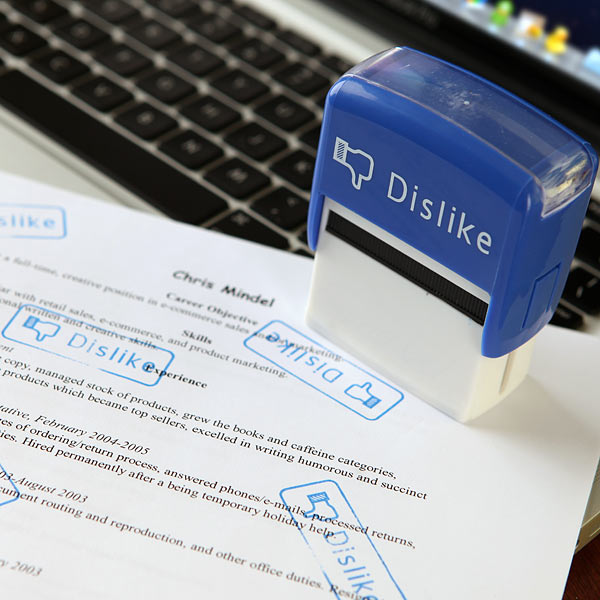
Image courtesy of ThinkGeek. Also, I really need to buy that stamp.
Thank you! I, too, and sick of buzzwords. If I hear the word factoid or sound byte or engaement one more time I think I might puke.Â
I use engagement a bit. Â Whoops.
Hilarious … and sooo true!
Â
Add “gamification” to the list! Gamification is a user engagement feature, not the solution. Unless your solution is providing gamification tools like Badgeville.
How to get on a ‘pitch list’? 😀
Also add green or environment friendly to the list of never use buzz words.
This is good. I am getting a little tired of reading that so many people are ‘passionate’ about their particular field or activity. Come on now, really?
I would argue that these this blacklist of buzzwords is not meant to be blanketed across all pitches. In particular, #1 can be used in certain applications. We use the word “disruptive” a few times with @PaidPunch:twitter because it correctly describes both our service and our strategy. My point being, that there is a balance between conventional and innovative. Some of these words, while completely annoying, are necessary.
How do I add you to an ignore list?
Good to know. Now I’ll think twice about using “engagement”Â
Going social and expanding in mobile… how many times…
I am really sick of the word “Leverage” and  I know it needs to be used, but I just feel it is used way to often in marketing. Â
Nick – are there other verbs you suggest leveraging in place of “leverage”? Â 🙂
To make it worse Nick, a lot of idiots here in England have suddenly started using it and adopting the American pronunciation. So the word originates from Lever [We say leever, as in beaver] so it’s leeverage naturally right? Oh no, people in their 40’s and 50’s who have been saying ‘leever’ their entire lives have suddenly forgotten their past and begun saying leverage in the American way. God it drives me mental. The fact that they even use it at all is maddening like you say. Have some originality you morons. ‘Influence’ is a better word. Traction is another new word that bird brains have picked up.
A good list and all very true (sadly) but one that could easily be titled “Top buzzwords that shouldn’t be used in articles.” It’s rare to go a day without reading about a “transformative new feature rumored to hit the new iPhone…” or about the new android device being billed as the first legitimate “[insert Apple product here] killer” – the Amazon Fire being a prime example of this.
I’m not saying the PR profession is faultless (there is much that needs to be improved) but let’s also consider the number of pieces that use these exact words to get page views. I think these carefully (or not) selected buzzwords offer both PR and the media equally as well.
Pretty much sounds like a typical Apple announcement to me. I assume you have chosen never to feature any of their releases for that reason … oh, er wait a minute. 😉
Perfect dude!
There is a post that don’t make any sense. It’s really from someone that don’t have SUCCEEDED yet.
Actually, for me there is a clear difference in Leading & Leader.
Add to the list any random buzzword combination that sounds like it came out of the Web Economy Bullshit Generator (http://www.dack.com/web/bullshit.html).
Epic and fail are right up there with disruptive.